Rshunt exponential behavior vs irradiance
The shunt resistance Rshunt - corresponding to the inverse of the slope of the I/V curve around V=0 - is considered as a constant parameter in the standard one-diode model.
However, when measuring I/V curves at different irradiance levels, we observe that the measured Rshunt value increases as irradiance decreases. This is valid for any PV cells technology, but it is especially visible with amorphous I/V curve families, where the Rshunt is very low (i.e. the I/V slope around Isc is important).
The next figure shows our measured Rshunt behaviour for one of our long-term measurements, for an amorphous module.
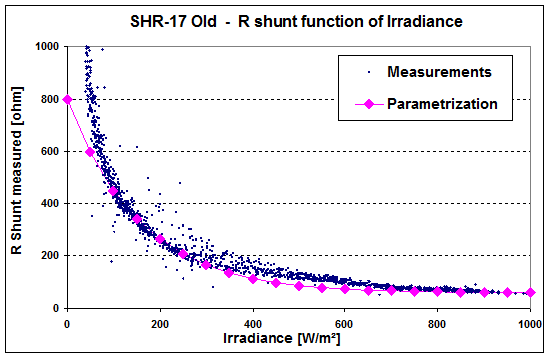
This distribution may be approximated by the following exponential expression:
RshBase value
The RshBase value is close to the Rshunt value at STC of the one-diode model. However if we require that this exponential expression passes indeed by Rshunt(STC) at 1000 W/m², we have to do a little correction. We can write the previous expression for 1000 W/m²:
By solving this equation we obtain:
General behaviour
We observed similar behavior across all our measured data (including Si-crystalline and CIS modules). Interestingly, all data can be well approximated using a single value RshExp = –5.5 (except for CdTe modules, where it is approximately –3). Therefore this value is set as default value in PVsyst.
This expression has 2 unknown parameters: Rshunt of the standard model at STC, and Rsh(0), the intercept at G = 0. These parameters may be determined on measured data, but are not available in the usual manufacturer's data sheets.
We have seen that when establishing the model at STC, in absence of an I/V curve measurement we choose a default value Rshunt = Vmpp / (0.2 * (Isc - Impp)).
Based on our long-term outdoor measurements of several modules:
- For amorphous modules, we observed a ratio of Rsh(0) / Rshunt = 12, which is very consistent across all measured modules, including CdTe. This exponential correction is extremely important in the model, as the RShunt is low, so its weight in the model is high.
- For Si-crystalline and CIS, we observed a fairly stable ratio of approximately Rsh(0) / Rshunt = 4, although this is harder to establish because crystalline module Rshunt is high, making the slope very low and difficult to measure accurately. Based on measured low-light flash-test data from many manufacturers, we estimate this ratio to be approximately 8 to 10. However, the exact ratio has minimal impact on the final model because Rshunt is already very high at STC, so its influence is negligible at higher values under low-light irradiance. Furthermore, its influence is accounted for when adjusting Rseries to achieve the desired low-light performance.
NB: When several Rshunt values are available for different irradiances, PVsyst provides a tool for adjusting the corresponding Rsh(Gref) and Rsh(0) parameters.