Cells normalized sizes
In the crystalline modules, the size of the cells continuously evolves from year to year.
This is due to increasing standard ingot diameters. Historically, cells of 4", 5" and 6" diameter were used.
Since 2012, the cell sizes have continuously evolved, and taken new denominations. The usual sizes passed progressively from 156, 166, 182, and up to 210 mm.
The largest cells can only be used as halves or thirds. The size of each individual cell is primarily limited by currents and module dimensions. Due to cell size increases and improved efficiencies, typical module currents have risen from less than 10 A to 15–16 A over the past decade. This has consequences on the specifications of the string design, inverters and possible optimizers.
The following table summarizes the evolution of standards and the cells' main properties. Some values may not be entirely reliable, as information can vary among different sources.
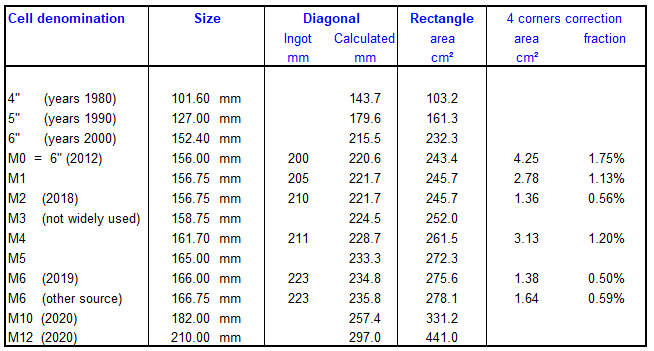
NB: Monocrystalline cells are cut from cylindrical ingots and therefore have cut corners. Full cells have 4 cut corners, while half-cells have only 2. The table provides an estimate of the corner correction to cell area.