Thin film modules: Recombination losses
Although it accurately models Voc behavior in crystalline and CIS modules, the standard model fails to reproduce the voltage behavior of amorphous modules under any irradiance or temperature condition.
Amorphous junctions differ from other junctions in their inclusion of an "intrinsic" layer (p-i-n junction). J. Mertens et al.1 propose accounting for recombination losses in this intrinsic layer by adding a term to the general I/V equation. This term is equivalent to adding an element to the equivalent circuit, representing a current leak depending on the photocurrent and the voltage.
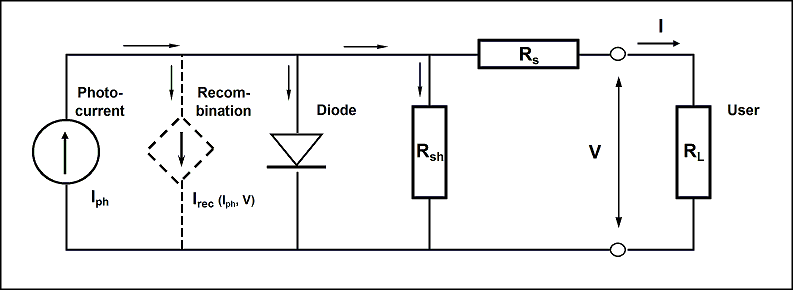
Modelling of this phenomenon leads, under some hypotheses, to the following expression for the recombination current:
where:
- di = Thickness of the intrinsic i-layer (of the order of 0.3 μm),
- μτeff = Diffusion length of the charge carriers p and n:
- μτeff = 2 · μn τn · μp τp / (μn τn + μp τp)
- Vbi = Intrinsic (built-in) voltage of the junction. Its value can be considered constant, at approximately 0.9 V for an amorphous junction.
With this new term the general one-diode model I/V expression becomes
I = Iph - Iph · di² / μτeff · 1 / (Vbi - (V + I Rs))
- Io [ exp (q · (V+I·Rs) / ( Ncs·Gamma·k·Tc) ) - 1 ] - (V + I·Rs) / Rsh
In our phenomenological study of 4 amorphous modules, we considered the quantity di² / μτeff as a single parameter and determined the value that optimized the Voc response of the model. For all our modules, we found that a value (di² / μτeff) around 1.4 V provides excellent results and effectively corrects the Voc distribution while simultaneously improving the Pmax response.
For example, on our SHR-17 triple-junction, the RMSE on Voc drops from 3.3% to 0.7%, and the MBE from 4% to 0.2% with this correction. Simultaneously, the RMSE on Pmax is improved from 5.8% to 4.1%.
It should be noted that this new term does not significantly modify the procedure for obtaining the model parameters. Rather, the photocurrent value is now affected by a voltage-dependent correction in the equations. However, solving the model yields a significantly different gamma value that is compatible with its "physical" limits.
-
J. Mertens, J. M. Asensi, C. Voz, A. V. Shah, R. Platz, J. Andreu
Improved equivalent circuit and Analytical Model for Amorphous Silicon Solar Cells and Modules.
IEEE Transactions on Electron Devices, Vol 45, No 2, Feb 1998. ↩